
 blog
blog
Engaging Math Games for Elementary Students
Table of Contents
- Why Engaging Math Games Improve Fluency and Number Sense
- Math Fluency Games for Addition, Subtraction, Multiplication, and Division
- Place Value Activities and Problem-Solving Games That Build Number Sense
- Coding and Math Integration: Turning Arithmetic Into Logic and Problem-Solving
- Standards-Aligned Math Activities for Small Groups and Learning Stations
- No-Prep and Low-Prep Math Games for Individual Practice and Math Centers
- Differentiation, Formative Assessment, and Home-to-School Connections
- Conclusion: Choosing Engaging Math Games That Actually Build Skills
- Frequently Asked Questions
Last Updated: October 1, 2026
Why Engaging Math Games Improve Fluency and Number Sense
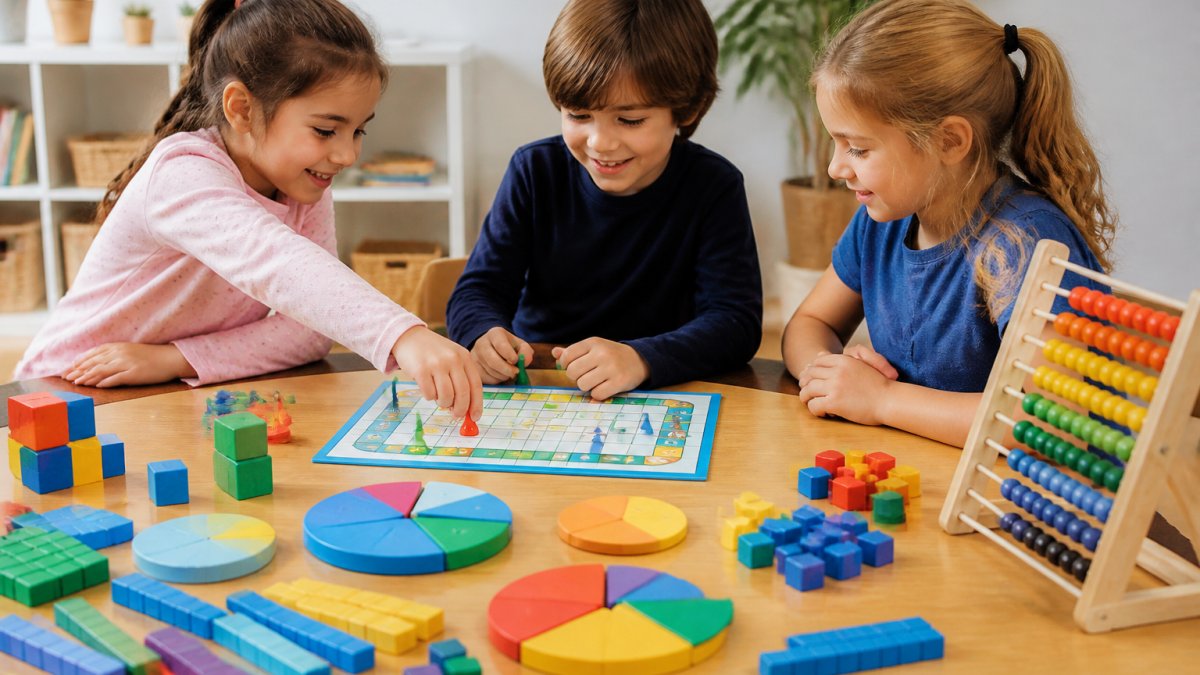
Engaging math games for elementary students turn repeated practice into something children want to do again. That matters, because repetition builds math fluency, and fluency builds confidence.
Math fluency is the ability to recall basic facts and procedures accurately, quickly, and without strain. It grows through short, frequent practice, not long grinding sessions. Games deliver that practice in small doses, with a scoreboard attached.
What Game-Based Practice Does That Worksheets Cannot
Worksheets ask for answers. Games ask for decisions.
That difference changes how the brain works. A worksheet gives one correct path. A game gives choices: which card to play, which move to make, how much risk to take. Students think harder when the outcome depends on their choices.
Games also lower math anxiety. A wrong answer in a game costs a point, not a grade. Kids take more risks, and risk-taking is where learning happens. Plus, games bring collaborative learning and peer-to-peer interaction into the room, which worksheets never do.
Math Fluency Games for Addition, Subtraction, Multiplication, and Division
The fastest way to build math fluency is through mental math games that force quick recall of arithmetic operations. The five below are classroom-tested, need almost no setup, and each targets a specific fact set. For each game, I've noted the grade band, the skill it builds, and one differentiation move so you can run it with a mixed-ability group.
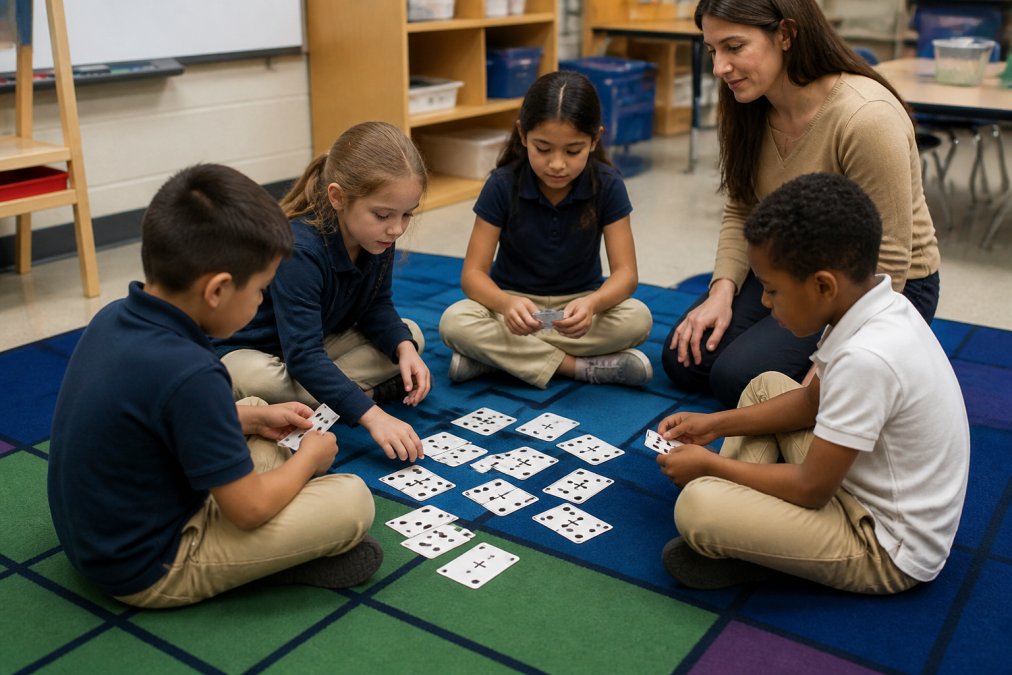
- Fact Family Shuffle (Grades 1-3), Deal four number cards (e.g., 3, 4, 7, 11). Students race to build two addition and two subtraction facts that use all four numbers. Differentiation: For students still using counters, allow a number line; for advanced students, require them to also write the related multiplication/division fact family when possible.
- Multiplication War (Grades 3-5), Each player flips two cards and multiplies. Higher product takes the pair. Play for ten minutes. Differentiation: Use a 0-5 deck for students new to facts; use a 6-10 deck for students ready for larger products.
- Roll and Cover (Grades K-2 for addition, 3-4 for multiplication), Roll two dice, add or multiply, and cover the answer on a printed grid. First to cover five in a row wins. Differentiation: Provide a pre-filled grid with answers for students who need support; give a blank grid for students who need a challenge.
- Around the World (Grades 1-5), One student stands behind a classmate. You call a fact. Whoever answers first moves on. Differentiation: Let students who need more think time use a personal fact card; pair students of similar speed so the game stays close.
- Target 100 (Grades 2-5), Players take turns adding numbers to a running total. The player who lands exactly on 100 wins. Differentiation: Start at 50 for younger students; require subtraction for advanced students (e.g., "you may add or subtract on your turn").
Quick Games for Mental Math and Arithmetic Operations
Mental math games work best in short bursts. Five to ten minutes, two or three times a day, beats one long session. A common pattern in strong classrooms is a "fluency warm-up" at the start of math block and a "fluency wrap-up" at the end, same game, different day, so students see their own speed improve.
Place Value Activities and Problem-Solving Games That Build Number Sense
Number sense is a student's gut-level understanding of how numbers relate, compare, and combine. Place value sits at the center of it. A child who truly gets place value can explain why 4,000 is ten times 400, not just write the digits in order.
Try these place value activities:
- Build the Biggest Number - Give each student four digit cards. They arrange them to make the largest number possible, then explain their reasoning.
- Place Value Bingo - Call out clues like "seven tens and three ones." Students cover the matching number.
- Digit Swap - Show a number, then move one digit. Ask what changed and by how much.
Coding and Math Integration: Turning Arithmetic Into Logic and Problem-Solving
Coding and math integration works because both subjects run on the same engine: precise, ordered thinking. When a student writes a loop that counts by fives, they are practicing multiplication with a purpose. When they debug an off-by-one error, they are doing place value in their head.
Standards-Aligned Math Activities for Small Groups and Learning Stations
Standards-aligned math activities should map to a specific skill, not just fill time. Before you plan a station, name the standard it targets. Then pick a game that practices exactly that skill.
| Station | Focus | Game | Time |
|---|---|---|---|
| Station 1 | Fact fluency | Multiplication War | 10 min |
| Station 2 | Place value | Build the Biggest Number | 10 min |
| Station 3 | Problem-solving | KenKen puzzles | 10 min |
| Station 4 | Coding and math | CodeAlgo Academy puzzles | 15 min |
No-Prep and Low-Prep Math Games for Individual Practice and Math Centers
No-prep games matter on busy days. These need nothing but paper, dice, or a device.
- Dice Double - Roll one die, double it, write the answer. Repeat for five minutes.
- Number of the Day - Write one number. Students list facts, factors, and place value breakdowns.
- Beat the Clock - Time a set of ten facts. Students try to beat their own time, not a classmate's.
- Estimation Station - Show a jar of objects. Students estimate and then count to check.
Differentiation, Formative Assessment, and Home-to-School Connections
-
Below grade level: Use smaller numbers, allow counters or manipulatives, and reduce the number of rounds. For a student with a learning disability in math, pre-teach the vocabulary ("product," "sum," "difference") and provide a visual anchor chart at the station.
-
At grade level: Play as written.
-
Above grade level: Add a rule, like "you must use two operations to reach the target," or ask the student to create a new round for the group.
-
Does the student count on fingers or recall facts?
-
Can they explain their strategy out loud?
-
Do they notice when an answer is impossible?
-
Do they adjust their strategy after a wrong answer?
Take-Home Game: Target 100 You need: a deck of cards (Ace = 1, face cards = 10) or two dice. How to play: Take turns adding your card to a running total. The first player to land exactly on 100 wins. If you go over 100, you lose that round. Talk about it: Ask your child, "How did you decide what to add?" and "What would you do differently next time?"
Conclusion: Choosing Engaging Math Games That Actually Build Skills
Picking the right game comes down to one question: does it make students think, or just answer? Games that force decisions, explanations, and quick recall build real skills. Games that only entertain waste class time.
A few things to check before you commit:
- Does the game target one clear skill?
- Can every student in the group take turns?
- Can you see evidence of learning in under a minute?
- Does it fit in ten minutes or less?
Frequently Asked Questions
How do engaging math games help elementary students learn?
Games give students repeated practice with arithmetic operations in a context that feels like play rather than drill. That repetition builds math fluency and number sense while lowering math anxiety, because mistakes carry less weight than they do on a graded worksheet. Games also push students into critical thinking and problem-solving as they plan moves, check answers, and adjust strategies. The result is more time on task and stronger retention of concepts like place value and mental math.
How can I integrate coding with math games for elementary students?
Start with a simple sequence game: students write or arrange steps to move a character a set number of spaces, then adjust when the result is wrong. That single activity blends coding and math integration with coordinate work, counting, and logic. Platforms built for K-8, such as CodeAlgo Academy, let teachers run these activities without any coding background, so the math objective stays the focus while students build procedural fluency and problem-solving skills.
What are some low-prep math games for elementary students?
Use what is already in the room. A deck of cards can drive addition and subtraction games, dice support place value activities, and a whiteboard works for quick mental math rounds. For no-prep options, try a number talk game where students justify an answer in 30 seconds, or a partner quiz where each student writes a problem for the other to solve. These fit into five-minute transitions, math centers, or early-finisher time without extra printing.
How do game-based learning platforms improve math fluency?
Adaptive platforms adjust difficulty as students play, so practice stays in the zone where they are challenged but not overwhelmed. That steady stretch builds math fluency faster than fixed worksheets, and built-in progress data gives teachers formative assessment information without extra grading. Look for a platform aligned to standards such as Common Core State Standards, with classroom tools, and available on web, iOS, and Android so students can practice in class or at home.
Building real math fluency takes more than a fun game here and there. It takes a steady path that grows with each student. CodeAlgo Academy gives you that path, with a standards-aligned curriculum, adaptive tools that adjust to each learner, and no coding background needed to teach it. Get started with CodeAlgo Academy and turn ten minutes of play into measurable math growth.