
 blog
STEM vs STEAM for Elementary Students: A 2026 Guide
Table of Contents
- What STEM and STEAM Mean for Elementary Students
- Key Differences Between STEM and STEAM for Elementary Learners
- STEM vs STEAM Examples: Real Classroom Projects
- STEM Activities for Elementary Students
- STEAM Activities for Elementary Students
- How to Integrate Art Into STEM Lessons
- Choosing Between STEM and STEAM for Your School or Home
- Frequently Asked Questions
Last Updated: October 5, 2026
What STEM and STEAM Mean for Elementary Students
STEM and STEAM are educational frameworks that shape how kids learn science, technology, engineering, and math. At CodeAlgo Academy, we help elementary students build critical thinking and problem-solving skills through these approaches. Understanding STEM vs STEAM for elementary students helps teachers and parents choose the right learning path.
STEM: The Foundation
STEM stands for Science, Technology, Engineering, and Mathematics, focusing on core technical and analytical skills.
A STEM project might involve designing a simple machine, coding a basic program, or running a science experiment.
STEM activities suit students who enjoy structured problem-solving and build confidence in math and technical skills. Many teachers use STEM as the foundation before introducing arts integration.
STEAM: STEM With Arts Integration
STEAM adds one crucial element to STEM: the Arts, including visual arts, music, dance, and creative design. STEAM stands for Science, Technology, Engineering, Arts, and Mathematics.
The key difference is that STEAM encourages creative expression alongside technical learning.
STEAM recognizes that creativity drives innovation. Combining technical skills with artistic thinking develops more flexible problem-solving, helping kids approach challenges from multiple angles.
Key Differences Between STEM and STEAM for Elementary Learners
The main distinction between STEM vs STEAM for elementary students comes down to how much creative expression is included.
Here's what changes in practice:
STEM emphasizes:
- Logical reasoning and step-by-step processes
- Data collection and analysis
- Testing and iteration based on measurable results
- Structured problem-solving with defined right answers
STEAM emphasizes:
- Creative expression and multiple valid solutions
- Artistic design and visual communication
- Imagination and experimentation without fixed outcomes
- Collaboration and personal interpretation
In elementary classrooms, STEM lessons often feel like science or math class, while STEAM lessons feel like art class mixed with science.
Teachers use STEM to focus on math skills or technical concepts, and STEAM to encourage imagination alongside learning. Many schools now blend both approaches throughout the year.
| Aspect | STEM | STEAM |
|---|---|---|
| Focus | Science, tech, engineering, math | Same + arts integration |
| Creative Expression | Limited | High |
| Problem Solving | One correct answer | Multiple solutions |
| Learning Style | Analytical and structured | Creative and flexible |
| Student Engagement | Logic-focused learners | Visual and creative learners |
| Real-World Connection | Technical careers | Design, innovation, creative tech |
STEM vs STEAM Examples: Real Classroom Projects
The best way to understand the difference is to see both approaches in action. Since a first grader and a fifth grader need different materials, time frames, and success criteria, below are paired STEM and STEAM projects banded by grade level.
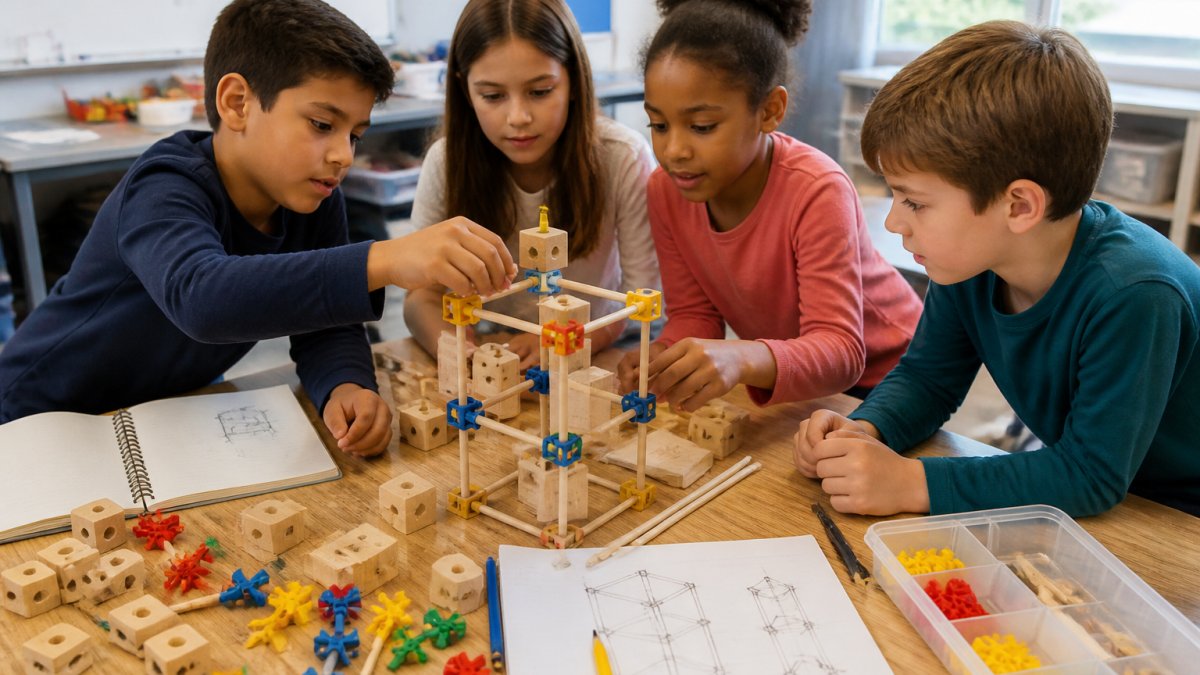
Early Elementary (Grades K-2): Shade Shelter for a Toy
STEM version, 30-40 minutes, one class period.
Materials per pair: one small toy figure, 10 index cards, 12 inches of masking tape, one 6-inch square of aluminum foil, a paper clip, and a ruler.
Students test, observe where light leaks in, and rebuild. Success is measurable: the toy stays in shadow.
STEAM version, same 30-40 minutes, same materials, plus one tray of crayons, colored paper scraps, and glue sticks.
The success criteria expand to two: does it block the light, and can the student describe why their design fits the toy.
Upper Elementary (Grades 3-5): Bridge That Holds Weight
STEM version, two 45-minute sessions.
Teams sketch two designs, choose one, and record the weight held on a class chart.
STEAM version, same two sessions, plus a 20-minute design studio block.
Same materials, plus paint, colored tape, and a one-page "bridge story" template.
Students write three sentences explaining how their artistic choices connect to the structure ("I used arches because the story is set in ancient Rome").
What Changes Between the Bands
| Element | K-2 | 3-5 |
|---|---|---|
| Session length | 30-40 min | 45 min × 2 |
| Team size | Pairs | Teams of 3 |
| Materials | 5-6 items | 6-8 items |
| Success criteria | 1 (STEM) / 2 (STEAM) | 1 measurable + 1 written (STEAM) |
| Iteration | 1-2 rebuilds | 1 formal redesign |
| Reflection | One spoken sentence | Three written sentences |
The pattern holds across both bands: STEM keeps success criteria tight and measurable, while STEAM adds a second, equally checkable criterion tied to expression. Neither drops the technical challenge, STEAM simply makes the creative choice part of what counts as success.
STEM Activities for Elementary Students
STEM activities work best when they're hands-on and connected to real problems, because elementary students learn by doing.
Effective STEM activities for elementary students include:
- Coding projects: Using block-based programming (like CodeAlgo Academy's game-based learning) to solve logic puzzles and build simple programs
- Engineering challenges: Building structures, machines, or devices with limited materials
- Science experiments: Testing hypotheses about how things work
- Math games: Using games to practice problem-solving and calculation
The best STEM activities have a clear goal and measurable success, so kids know when they've solved the problem and can test ideas with immediate results.
STEM activities build persistence: when a design fails, students try again with a different approach, developing resilience and analytical thinking they'll use throughout their education.
STEAM Activities for Elementary Students
STEAM activities blend creative expression with technical learning and work best when students can explore and personalize their work.
Effective STEAM activities for elementary students include:
- Design challenges: Creating solutions that are both functional and beautiful
- Art-integrated coding: Making visual programs that create patterns or animations
- Creative engineering: Building structures that tell a story or express an idea
- Music and math: Exploring patterns in music and rhythm
STEAM activities encourage imagination. There's no single right answer. A student might solve a design challenge in five completely different ways, and all could be valid.
These activities help students see connections between subjects, realizing art isn't separate from science but another way to express scientific thinking.
How to Integrate Art Into STEM Lessons
Teachers don't need to choose between STEM and STEAM. They can integrate art into an existing STEM lesson with a repeatable structure. Below is a concrete walkthrough plus adaptations for common classroom constraints.
A 60-Minute Integration Template
Use this with any STEM challenge you already teach.
- 0-5 min, Frame the technical problem. State the measurable goal ("span 10 inches," "hold 2 pounds," "keep the toy in shadow"). Write it where students can see it.
- 5-15 min, Sketch and plan. Teams draw two designs and circle the one they'll build. This is where artistic thinking first enters: shape, proportion, and story all show up in the sketch.
- 15-40 min, Build and test. Students construct, test against the measurable goal, and note what failed. Keep the technical criteria visible.
- 40-50 min, Add the expressive layer. Introduce the second criterion: the design must represent a place, tell a story, or reflect a theme. Provide art materials now, not earlier, so the engineering work isn't rushed.
Materials That Work at Any Budget
- No budget: recycled cardboard, newspaper, tape, scrap paper, pencils, and any found natural materials.
- Low budget: the above plus one tray of markers, colored paper, and glue sticks per table.
- Full budget: add paint, clay, fabric scraps, and simple LEDs for light-based projects.
The art materials don't need to be fancy, integration works because of the second success criterion, not the supplies.
Adapting for Class Size and Resources
- Large classes (28+): run the build in teams of three with defined roles, builder, tester, documenter. Rotate roles on the second project so every student builds and every student tests.
- Limited materials: cap each team at a fixed count (for example, 30 sticks, 12 inches of tape). Scarcity forces iteration and makes the engineering trade-offs visible.
- No dedicated art time: fold the expressive layer into the last 10 minutes of the same session. The rubric still applies.
- Push-in or co-taught rooms: the art teacher or specialist can own the 40-50 min block while the classroom teacher runs testing.
A Simple Rubric for Integrated Projects
Score each row 1-3 (emerging, meeting, exceeding).
| Criterion | What to look for |
|---|---|
| Technical goal | Did the build meet the measurable target? |
| Iteration | Did the team test, identify a failure, and revise? |
| Expressive choice | Can the student explain how the design reflects the theme or story? |
| Collaboration | Did each team member contribute a build, test, or documentation role? |
| Communication | Did the team clearly present both the technical result and the artistic intent? |
Keep the rubric to one page. Students should see it before they build, not after.
Avoiding the "Decoration Trap"
The most common failure mode is treating art as a finishing step, paint slapped on at the end. That isn't STEAM; it's STEM with glitter. Real integration means the artistic choice shapes the design. If a student's bridge theme is "a bridge for a desert city," that should influence the shape, the materials, and the structural choices, not just the color.
The integration template works because it keeps two criteria visible at once: one measurable, one expressive. That's the practical difference between STEM and STEAM in an elementary classroom, not the supplies, but what counts as success.
Choosing Between STEM and STEAM for Your School or Home
The choice between STEM and STEAM depends on your goals and students' needs. Neither is better; they serve different purposes.
Choose STEM if you want to:
- Build strong foundational math and technical skills
- Develop logical reasoning and analytical thinking
- Focus on structured problem-solving
- Prepare students for technical careers
- Use data and measurable outcomes to track progress
Choose STEAM if you want to:
- Encourage creative thinking and imagination
- Help students see connections across subjects
- Build confidence in students who learn visually or artistically
- Develop innovation and design thinking
- Engage students who might not see themselves as "math kids"
The best approach often combines both. Many schools teach STEM and STEAM units throughout the year, some emphasizing technical skills, others creative expression, giving students a complete education.
At CodeAlgo Academy, we build both analytical and creative thinking through game-based learning.
The real power comes from combining approaches. Students who can think both analytically and creatively are better problem-solvers. They're ready for careers in any field because they can analyze data AND imagine new possibilities.
Consider your students' learning styles, resources, and curriculum goals. Many elementary teachers start with STEM to build confidence, then add STEAM elements to deepen engagement; others do both simultaneously.
Most elementary teachers feel pressure to teach everything.
Frequently Asked Questions
What is the difference between STEM and STEAM for elementary students?
STEM focuses on science, technology, engineering, and mathematics through hands-on, problem-solving activities. STEAM adds arts, visual arts, music, language arts, and humanities, to create integrated, creative learning. Both build critical thinking, but STEAM emphasizes creative expression and design thinking alongside technical skills. For elementary students, STEAM often increases engagement by allowing students to explore multiple ways of solving problems and expressing ideas.
Which approach is better: STEM or STEAM for elementary learning?
Neither is inherently better; it depends on your goals and students. STEM excels at building strong foundational math and coding skills through structured problem-solving. STEAM broadens this by incorporating creativity, collaboration, and communication, skills employers and colleges increasingly value. Many schools now blend both, using STEM for focused skill-building and STEAM for project-based, interdisciplinary learning. The best choice aligns with your curriculum standards and student needs.
Can teachers without coding or art experience teach STEM or STEAM?
Yes, absolutely. Teachers don't need prior coding or art expertise to facilitate STEM or STEAM learning. Structured platforms with built-in curriculum and adaptive guidance, like game-based learning tools, remove the barrier of needing specialized knowledge. These tools guide both teachers and students through hands-on activities, project-based learning, and problem-solving. Many teachers report that learning alongside their students builds confidence and enthusiasm for the material.
What are examples of STEAM activities that combine art with STEM?
STEAM activities blend creativity with technical learning. Examples include designing and decorating a bridge using engineering principles and visual design, coding animations with artistic themes, building a robot and then decorating it to reflect a character or story, creating data visualizations as artwork, or designing a sustainable garden that incorporates mathematics, science, and visual planning. These projects help students see how arts enhance problem-solving and make learning more engaging and memorable.