 listicle
7 Benefits of Game Based Learning in Math That Stick
Table of Contents
- Why Game Based Learning in Math Changes How Students Think
- Benefit 1: Stronger Problem-Solving and Critical Thinking
- Benefit 2: Better Focus, Memory, and Retention
- Benefit 3: Motivation That Doesn't Depend on Grades
- Game-Based Learning vs. Gamification: What's the Difference?
- Classroom Math Game Examples That Work in K-8
- Coding Games for Math Learning: Where Skills Connect
- Game-Based Learning Strategies for Teachers
- What This Means for Your Classroom
- Frequently Asked Questions
Last Updated: October 8, 2026
Why Game Based Learning in Math Changes How Students Think
Game based learning in math is an instructional approach that teaches mathematical concepts through structured play, where the game mechanics themselves require students to apply math skills to progress. At CodeAlgo Academy, we build our K-8 curriculum on this principle because it changes the learner's relationship with the subject: math stops being a worksheet to survive and becomes a puzzle to solve.
The distinction matters more than most educators realize. A student who memorizes a times table can recite it. A student who has spent twenty minutes adjusting variables in a game to hit a target score understands why that table works. That second student carries the concept into algebra, coding, and eventually the workplace.
Below, we break down seven benefits of game based learning math instruction, along with the strategies that make it work in real classrooms.
Benefit 1: Stronger Problem-Solving and Critical Thinking
The first and most durable benefit is sharper problem-solving. Games present a goal, a set of constraints, and limited resources, which is the same structure as any real-world math problem. Students learn to break a challenge into steps, test an approach, fail safely, and try again.
A common mistake is treating this as a side effect of fun. It is not. The problem-solving loop is the mechanism. When a student loses a level because they miscalculated a ratio, they feel the consequence immediately and adjust. That feedback cycle, repeated dozens of times per session, builds reasoning habits that worksheets rarely produce because worksheets grade hours later.
According to Edutopia's topic page on game-based learning, game-based activities can increase engagement while also supporting social-emotional skills like persistence and collaboration. That combination is exactly what critical thinking requires: the willingness to keep working on a hard problem.
Benefit 2: Better Focus, Memory, and Retention
Retention improves when students care about the outcome. Game based learning math instruction ties memory to consequence, so facts and procedures stick because they were needed to win, not because they were assigned. This emotional investment transforms high-stakes problem solving into a manageable challenge, effectively overcoming math anxiety by shifting the focus from the fear of failure to the mechanics of success.
Several education publishers document this pattern. Legends of Learning's article on game-based learning advantages connects game-based learning with better focus, stronger memory, and sharper problem-solving, and links those skills directly to test preparation. NewPath Learning's summary of game-based learning benefits identifies improved retention of learned material alongside increased engagement and attention span.
The practical takeaway for teachers: short, frequent game sessions beat long, occasional ones. Fifteen focused minutes, three times a week, builds more durable recall than a single hour-long session because the repetition is spaced.
Benefit 3: Motivation That Doesn't Depend on Grades
Intrinsic motivation is the quiet advantage of well-designed games. Students replay levels to beat their own score, which means they are voluntarily practicing math after the lesson ends.
This is where the difference between a good game and a bad one becomes obvious. A game that rewards speed alone teaches rushing. A game that rewards accuracy and strategy teaches patience. Teachers should test this themselves before assigning anything: play the first three levels and ask whether the scoring system rewards the behavior you want to see.
Game-Based Learning vs. Gamification: What's the Difference?
Game-based learning is when the learning content is delivered through an actual game, so playing the game requires learning the material. Gamification is when game elements like points, badges, or leaderboards are added to a non-game activity, such as a quiz or a homework tracker.
The distinction matters because they produce different results. Accelerate Learning's comparison of game-based learning and gamification lays out the differences clearly, noting that the two approaches serve different instructional purposes.
| Feature | Game-Based Learning | Gamification |
|---|---|---|
| Core activity | The game itself teaches the skill | A normal lesson with added rewards |
| Student motivation | Comes from playing and progressing | Comes from points, badges, rankings |
| Best for | Building deep understanding | Boosting completion and participation |
| Example | Solving ratio puzzles to advance a level | Earning a badge for finishing a quiz |
Gamification can lift participation, but it rarely deepens understanding on its own. If your goal is measurable math growth, game-based learning does more of the work.
Classroom Math Game Examples That Work in K-8
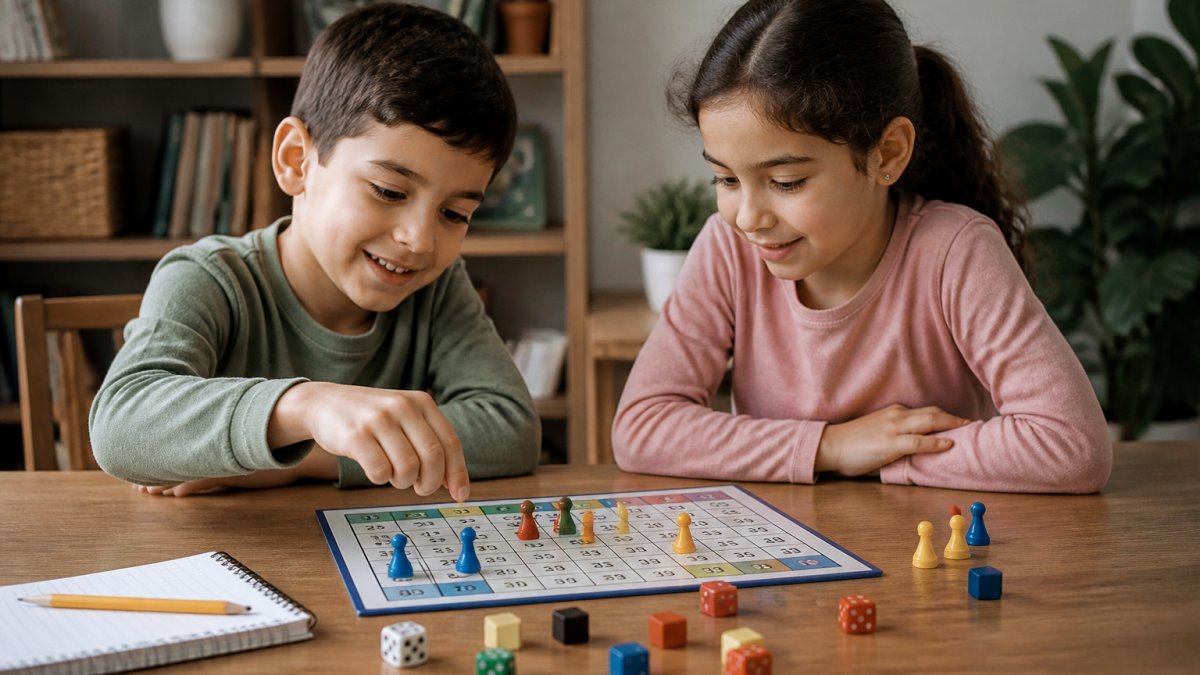
The most effective classroom math game examples pair a clear math objective with a mechanic students already understand. Three formats work consistently across K-8:
- Number-line races (K-2): Students move a token along a number line by solving addition and subtraction problems. The math is the movement.
- Fraction pizza builders (grades 3-5): Students combine fractional ingredients to complete a recipe, which forces equivalent fractions and common denominators.
- Variable puzzles (grades 6-8): Students adjust inputs in a simple simulation, such as a game character's speed or jump height, to hit a target outcome, which introduces algebraic thinking.

Each of these examples shares one trait: the math is not decoration. Remove the math and the game cannot be played. That is the test to apply to anything you bring into the classroom.
Coding Games for Math Learning: Where Skills Connect
Coding games for math learning work because code is math made visible. When a student writes a loop that repeats ten times, they are working with multiplication. When they set coordinates to move a character across a screen, they are working with the coordinate plane.
This connection is why CodeAlgo Academy pairs coding and math in a single curriculum rather than treating them as separate subjects. Students solve problems, see the result instantly, and adjust. The platform aligns to standards including CSTA and Common Core State Standards, runs on web, iOS, and Android, and requires no coding background from the teacher.
For schools weighing options, the question to ask is not "which game is most fun" but "which game produces measurable growth." That is a harder claim to make, and it is the one that matters to a principal or a board.
Game-Based Learning Strategies for Teachers
The right strategies for teachers come down to structure, not enthusiasm. A game without a debrief is entertainment; a game with a debrief is instruction.
- Set one clear math objective per session and state it before students log in
- Keep sessions short and frequent rather than long and rare
- Pair students so they explain their reasoning to each other
- Debrief for five minutes: ask what strategy worked and why
- Track progress against a specific skill, not just time on task
- Rotate game types so students practice transfer, not one mechanic
Teachers who have never coded often worry they will confuse students by trying. In practice, the opposite happens. When the platform handles the technical setup, the teacher's job is facilitation: asking questions, grouping students, and reviewing the data the game produces.
What This Means for Your Classroom
The case for game based learning math instruction rests on a simple shift. When students play to learn rather than learn to pass, the skills they build, problem-solving, retention, and persistence, carry past the test.
CodeAlgo Academy was built for exactly this. Our K-8 platform turns coding, math, and AI literacy into game-based experiences with adaptive learning paths, classroom tools, and healthy, purposeful screen time. Teachers need no coding background, and schools get a standards-aligned curriculum with measurable math assessment growth. Students have already solved 41,928+ coding problems across 10 states.
As one middle school teacher put it: "CodeAlgo came to our middle school and made a tremendous impact on our future computer scientists."
Frequently Asked Questions
What are the benefits of game-based learning in math?
Game-based learning in math builds problem-solving and critical thinking skills, improves focus and memory, and increases student engagement. According to Legends of Learning, game-based learning supports sharper problem-solving and better test preparation. NewPath Learning notes improved retention and attention span. When games are tied to standards, as CodeAlgo Academy does with Common Core State Standards, students practice math in a context that feels purposeful rather than repetitive.
How do math games help elementary students learn?
Math games give elementary students immediate feedback, which helps them adjust their thinking in real time. They also turn abstract concepts into concrete actions: counting, comparing, building, and predicting. Edutopia notes that game-based activities can increase engagement and support social-emotional skills. For K-8 learners, this means less fear of mistakes and more willingness to try again. Games also let students practice the same skill multiple times without it feeling like drill work.
What is the difference between game-based learning and gamification?
Game-based learning uses a game as the main way students learn, while gamification adds game elements like points, badges, or leaderboards to an existing lesson. Accelerate Learning explains that game-based learning is built around the game itself, not just rewards layered on top. In math, a game-based approach might have students solve puzzles to advance a story, while gamification might give points for completing a worksheet. Both can work, but game-based learning tends to build deeper thinking.
How can coding games support math learning?
Coding games ask students to sequence steps, spot patterns, and debug logic, all of which reinforce math thinking. When students write a loop to repeat a shape or set coordinates to move a character, they practice geometry, algebra, and number sense in a concrete way. CodeAlgo Academy combines coding and math in one platform, so students build both skills at once. The platform has logged over 41,928 coding problems solved across 10 states, showing that this approach works at scale.
If your students can recite math facts but freeze when a problem changes shape, the gap is not effort. It is practice that never asked them to think. CodeAlgo Academy closes that gap with game-based lessons that require reasoning, adaptive paths that meet each student where they are, and classroom tools that let any teacher run the session without a coding background. Get started with CodeAlgo Academy and turn screen time into measurable math growth.