 listicle
How to Set Up Low Prep Math Centers for Elementary Students
Last Updated: November 1, 2026
Quick Summary
Low prep math centers are station-based activities that need minimal printing, cutting, or laminating before students can use them. Aim for setup time under 15 minutes, one clear task, and a reset routine students can follow without prompting. Rotate four stations weekly in 15- to 20-minute blocks so centers run without you.
- Kindergarten and first grade rotations work best at 12 to 15 minutes, while grades 3-5 can handle 20.
- Teach the station routines in a full session before introducing any math content that day.
- Use a visual rotation board so students check station assignments instead of asking you.
- Change one differentiation dial per group: the numbers, the materials, or the output.
- Slide printed task cards into dry-erase sleeves instead of laminating them.
Table of Contents
- Why Low Prep Math Centers Work for Elementary Classrooms
- Elementary Math Center Ideas That Take Under 15 Minutes to Set Up
- Kindergarten Math Centers: Counting and Number Sense Without the Cutting and Laminating
- Math Stations for Elementary Students: A Weekly Rotation Plan You Can Reuse
- Math Center Activities With Manipulatives: Addition, Subtraction, and Fractions
- Differentiation, Accessibility, and Progress Monitoring at Each Station
- Start Your First Rotation With CodeAlgo Academy
- Frequently Asked Questions
Why Low Prep Math Centers Work for Elementary Classrooms
Low prep math centers are station-based activities that need minimal printing, cutting, or laminating before students can use them.
Centers give you time for small-group instruction while the rest of the class works independently, but only if the stations run without you.
Three things separate centers that last from centers that collapse by week three:
- Setup time under 15 minutes, using materials you already have
- One clear task, so students do not need a verbal walkthrough
- A reset routine students can follow without prompting
The rest of this guide gives you grade-banded ideas with exact materials and prep times, a reusable weekly rotation, and the management routines that hold it all together.
Elementary Math Center Ideas That Take Under 15 Minutes to Set Up
The fastest centers share one trait: the materials do the teaching. Below are eight centers organized by grade band, each with exact materials, prep time, setup steps, and a differentiation note.
Kindergarten and Grade 1 Centers
Counting Tub (2 minutes prep). Materials: one plastic tub per pair, 20 counters, and number cards 1-20. Setup: place a number card in each tub and fill with counters. Students count out the matching quantity and leave the rest in the tub.
Roll and Cover (5 minutes prep). Materials: one printed or hand-drawn 1-12 grid per student, two dice, and counters. Setup: slide the grid into a dry-erase sleeve and add dice and counters to a bin. Students roll two dice, add the numbers, and cover the sum. Reset: clear the counters and roll again. Differentiation: provide a number line for students who need support adding; use a 1-6 grid and one die for numeral recognition.
Number Line Walk (3 minutes prep). Materials: masking tape and a marker. Setup: tape a line on the floor and write numbers 0-20 at even intervals. Students stand on a number, step forward or back the number of spaces you call, and say the number they land on. Reset: none.
Grades 2-3 Centers
Card Sort (10 minutes prep). Materials: 12 index cards and a marker. Setup: write six equations on six cards and their answers on the other six. Students match equation to answer. Reset: shuffle and return to the bag. Differentiation: use addition and subtraction within 20 for grade 2; use multiplication facts within 10 for grade 3. Twelve cards is plenty for a ten-minute station, a larger deck is a common mistake.
Build and Record (5 minutes prep). Materials: counting cubes in two colors and a recording sheet. Setup: place a bin of cubes and a stack of recording sheets at the station. Students build an addition fact with two colors, then write the matching equation. Swap to subtraction by removing cubes. Reset: return cubes to the bin and stack the sheets. Differentiation: provide a number bond template for students who need structure; ask students to write the related subtraction fact for students ready to extend.
Base-Ten Exchange (7 minutes prep). Materials: base-ten blocks (ones and tens) and a recording sheet. Setup: place a bin of blocks and a stack of sheets at the station. Students trade ten ones for one ten and record each trade. Reset: return blocks to the bin. Differentiation: start with two-digit numbers for regrouping; use three-digit numbers for students ready to extend.
Grades 4-5 Centers
Fraction Tile Match (8 minutes prep). Materials: fraction tiles and a recording sheet. Setup: place a set of fraction tiles and a stack of sheets at the station. Students find two tiles that together equal one half, then record the pair. Reset: return tiles to the bin. Differentiation: use halves and quarters for unit fractions; use eighths and twelfths for equivalent fractions. Integrating these tactile fraction tiles into your classroom routine mirrors the hands-on philosophy found in Montessori learning materials, which encourage students to build a deeper conceptual understanding of mathematical relationships through physical manipulation.
Task Card Bin (12 minutes prep). Materials: printed task cards, dry-erase sleeves, and dry-erase markers. Setup: slide each task card into a sleeve and place in a bin with markers. Students solve the problem on the card and wipe clean. Reset: wipe the sleeves and return to the bin. Differentiation: color-code cards by difficulty, green for on-level, blue for support, red for extension, so students can choose or be assigned the right level.
Printable and No-Cost Options
Printable centers only save time if you skip the lamination queue. Slide printed task cards into dry-erase sleeves and you get the same durability with a fraction of the prep. For no-cost options, the free guided math center samples for grades 3-5 from Jennifer Findley give upper-elementary teachers a ready starting point. Pair them with a simple storage system: one folder per center, labeled by skill, so students can grab and return without asking.
Digital Centers for Healthy Screen Time
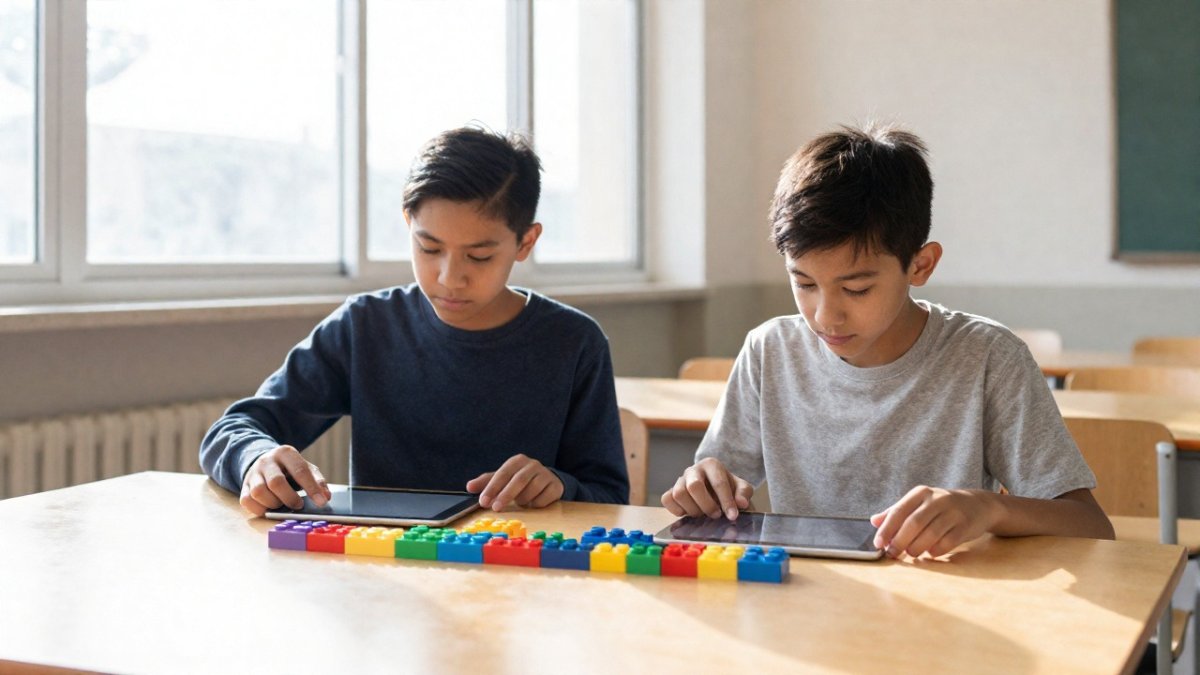
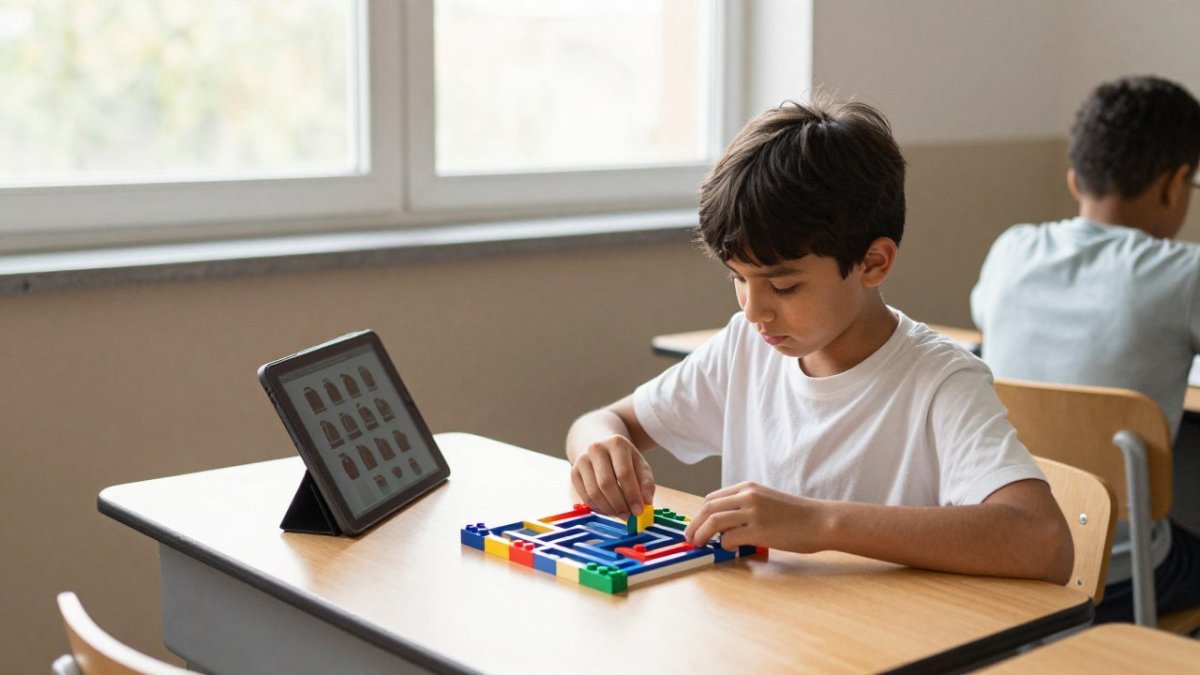
Digital centers work when the screen does the thinking, not just the tapping. Look for programs that adapt to student responses and show you the data afterward. Before adding any app to your rotation, check three things: does it adapt difficulty based on student answers, can you see individual attempt data rather than just a completion checkmark, and does a session end in under 15 minutes. If you want to weigh the research on classroom screen use before committing, the guide on whether educational screen time is healthy for kids covers the parental-involvement angle in more detail.
Kindergarten Math Centers: Counting and Number Sense Without the Cutting and Laminating
Kindergarten centers fail for one reason: too many small pieces. Five-year-olds need large, sturdy materials and a task they can start without reading.
Skip the laminated card sets. Use what is already in the room:
- Counting bins: one tub per pair, filled with counters and a number card. Students count out the matching quantity.
- Number line walk: a masking-tape line on the floor. Students step to a number you call, then count forward.
- Roll and stack: dice plus counting cubes. Roll, stack that many, compare stacks with a partner.
Prep time for all three sits under ten minutes, and none of them need cutting. The counting bins reset in about two minutes because everything goes back in the tub.
Number sense grows through repetition with variation, not through novelty. If you want a wider bank of game-based options, the collection of engaging math games for elementary students includes standards-aligned activities you can drop straight into a center.
Math Stations for Elementary Students: A Weekly Rotation Plan You Can Reuse
A reusable rotation is the difference between centers that run themselves and centers that run you. The plan below uses four stations and rotates every group through all four across a week.
| Day | Group A | Group B | Group C | Group D |
|---|---|---|---|---|
| Monday | Teacher-led | Independent practice | Hands-on manipulatives | Digital |
| Tuesday | Digital | Teacher-led | Independent practice | Hands-on manipulatives |
| Wednesday | Hands-on manipulatives | Digital | Teacher-led | Independent practice |
| Thursday | Independent practice | Hands-on manipulatives | Digital | Teacher-led |
| Friday | Review and reset | Review and reset | Review and reset | Review and reset |
You teach the same mini-lesson four times, once per group. That repetition is a feature, not a flaw: you can adjust the explanation each round based on what the previous group struggled with.
How Long Each Rotation Should Last
Fifteen to twenty minutes per rotation suits most elementary classrooms. Kindergarten and first grade do better at twelve to fifteen minutes. Grades 3-5 can handle twenty.
Watch the transition, not the clock. If students are still working when the signal sounds, the rotation is too short. If half the group is wandering by minute twelve, it is too long. Adjust in five-minute increments and leave it alone once it fits.
Classroom Management and Independent-Work Routines
Centers collapse on the management side, not the content side. Three routines prevent most problems.
Teach the station before you teach the math. Spend a full session modeling how to get materials, where to work, and how to put things back.
Use a visual rotation board. Group names on one side, station icons on the other. Students check the board instead of asking you.
Set a finished-early task. A small puzzle bin or a fluency game for early finishers stops the drift toward off-task behavior.
Rushing is the most common issue at independent stations. If students are speed-running the task to reach a reward, the strategies in how to stop students from rushing through work address the motivation side directly.
Math Center Activities With Manipulatives: Addition, Subtraction, and Fractions
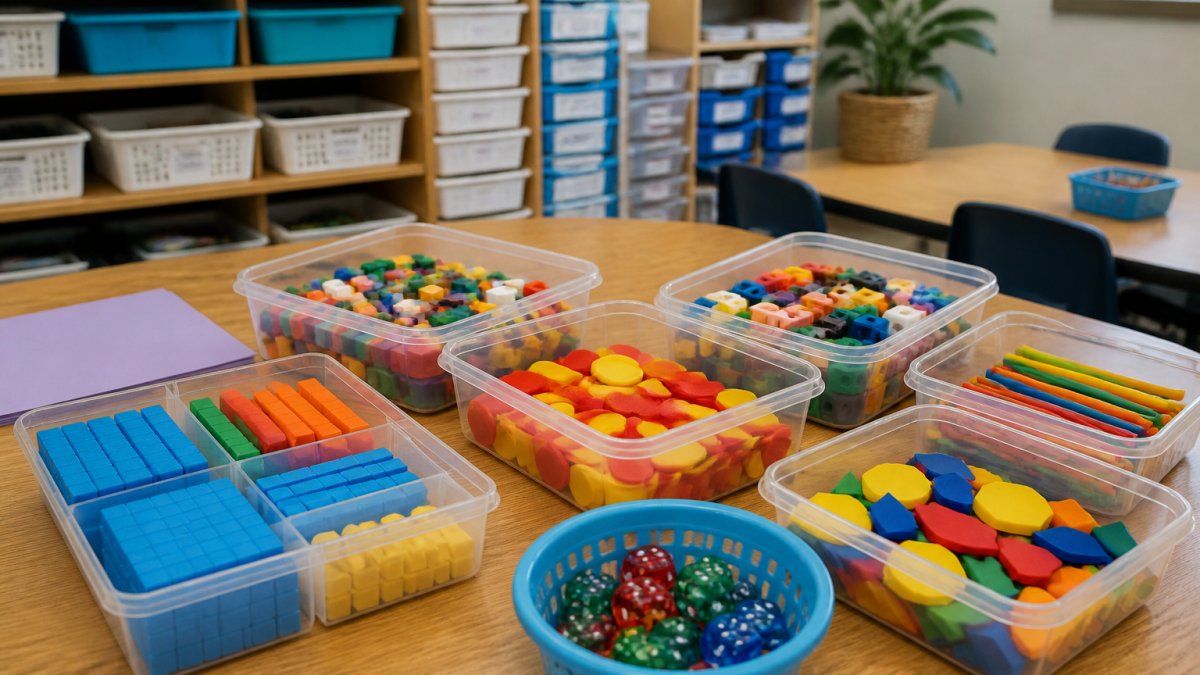
Manipulatives earn their place when they make an abstract idea visible. Counting cubes for addition and subtraction, fraction tiles for parts of a whole, and base-ten blocks for regrouping all do that job.
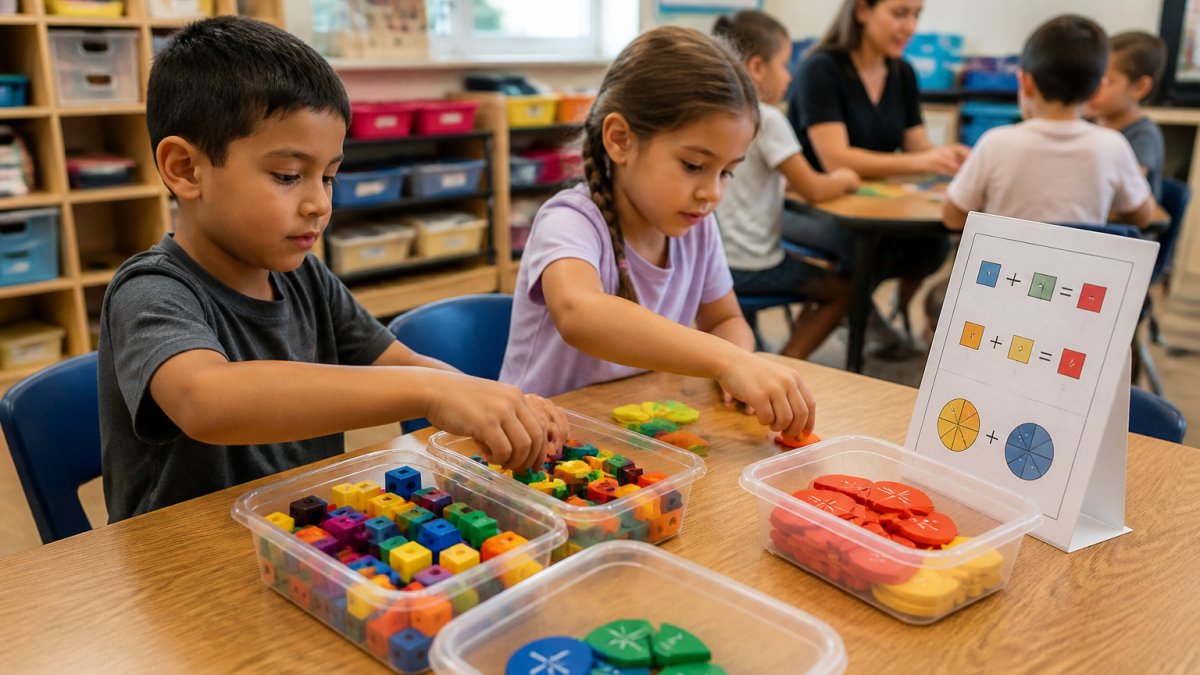
Three activities that need almost no prep:
- Cube build and record: students build an addition fact with two colors of cubes, then write the matching equation. Swap to subtraction by removing cubes.
- Fraction tile match: students find two tiles that together equal one half, then record the pair.
- Base-ten exchange: students trade ten ones for one ten, recording each trade as they go.
The rule for manipulatives is simple: if students can get the answer faster without the materials, the materials are decoration. Choose tasks where the manipulative reveals the structure of the problem.
Differentiation, Accessibility, and Progress Monitoring at Each Station
Differentiation at a center comes down to three dials: the numbers, the materials, and the output. Change one dial per group rather than building separate activities. The table below shows how to adapt any center from the previous section for three readiness levels without extra prep.
| Dial | Support Level | On-Level | Extension |
|---|---|---|---|
| Numbers | Smaller range (e.g., sums to 10) | Grade-level range | Larger range or multi-step |
| Materials | Counters, number line, number bond template | Manipulatives as needed | Abstract only |
| Output | Verbal explanation or pointing | Written equation or recording sheet | Written explanation of strategy |
For multilingual learners, pair every task card with a visual example and a word bank of key terms (sum, difference, equal, half). A quick sketch on an index card takes under a minute and removes the language barrier without changing the math.
Progress monitoring at centers works when you capture evidence as it happens. Math games are one of the easiest places to gather this evidence; the guide on using math games for formative assessment explains how to plan, observe, and adjust instruction from what you see at the table.
If you need adaptive practice to differentiate for students who struggle with problem-solving, the comparison of adaptive math learning platforms for kids covers features and fit for K-8 learners.
Start Your First Rotation With CodeAlgo Academy
Setting up centers that run themselves is the hard part. Keeping them stocked with meaningful practice all year is harder.
CodeAlgo Academy handles the second problem. Our K-8 platform turns math, coding, and AI literacy into game-based learning.
Pick one station, one routine, and one week. Get started with CodeAlgo Academy and put a digital center in your first rotation.
Frequently Asked Questions
What are some low prep math centers for elementary students?
The lowest-prep options are ones that use materials you already have or can print once. Number webs for math fact practice, counting-cube task cards, fraction-tile sorting mats, and roll-and-cover games need only dice, counters, or a single printed sheet. Digital centers need no printing at all. Aim for activities that take under 15 minutes to assemble and can be reused across rotations, so your setup time drops after the first week.
How long should elementary students spend at each math center?
Most elementary classrooms run 12-20 minute rotations, with younger students closer to 10-12 minutes and grades 3-5 closer to 15-20. Kindergarten math centers work best when kept short and highly hands-on, since attention drops fast. Build in a two-minute cleanup signal before each switch so transitions do not eat into the next station's time.
How can teachers differentiate math center activities?
Keep the activity the same and change the numbers. A counting-cube station can serve one group working on numbers to 10 and another on numbers to 100 using identical materials. Add a challenge card for early finishers rather than a separate center. For students who need support, pair the manipulative with a visual model and a printed example so they can start without waiting for you.
What materials do you need for math centers with manipulatives?
A practical starter kit is counting cubes, two-color counters, dice, fraction tiles, base-ten blocks, and small plastic bins for storage. Printable task cards and dry-erase sleeves cover most skill practice. Budget-friendly options include paper clips, beans, and bottle caps for counting. Label each bin by skill so students can grab and return materials independently, which keeps your prep time low week to week.