 ultimate-guide
Teaching AI Literacy in K-8 Schools: A Complete Guide
Table of Contents
- What AI Literacy Means for K-8 Students
- Why Teaching AI Literacy in K-8 Schools Matters
- How to Explain Generative AI to Middle Schoolers
- AI Literacy Curriculum for Elementary Students
- Tools for Teaching AI in the Classroom
- AI Ethics for Kids Lesson Plans
- Assessing AI Literacy and Measuring Student Growth
- Implementing AI Literacy in Your School
- Frequently Asked Questions
Last Updated: October 11, 2026
What AI Literacy Means for K-8 Students
Teaching AI literacy K-8 means helping students understand how artificial intelligence works, recognize its strengths and limitations, and use it responsibly.
At CodeAlgo Academy, we define AI literacy as the foundational knowledge that allows students to comprehend AI systems, question their outputs, and understand the ethical implications of artificial intelligence in society. This isn't about coding expertise. Instead, it's about building awareness and skepticism in a world where AI increasingly shapes information, recommendations, and decisions.
Students with strong AI literacy can identify when an AI tool makes a mistake, recognize biased training data, and understand why an algorithm might give different results than expected.
Why Teaching AI Literacy in K-8 Schools Matters
The case for teaching AI literacy in K-8 schools is straightforward: students will work alongside AI systems throughout their lives, whether they pursue STEM careers or not. The question isn't whether they'll encounter AI, it's whether they'll understand it.
Many schools currently teach coding or computer science, but AI literacy is different. It's about literacy, not programming.
Beyond career readiness, AI literacy builds critical thinking. When students learn to question AI outputs, evaluate sources, and recognize patterns in how algorithms behave, they develop skills that transfer across subjects. A student who understands that AI can be biased learns to think critically about all information sources.
How to Explain Generative AI to Middle Schoolers
Start with something concrete: ChatGPT and similar tools are pattern-matching machines trained on enormous amounts of text from the internet. They predict the next word based on patterns they learned.
For middle schoolers, use this analogy: imagine a tool that has read millions of sentences and learned which words tend to follow other words.
Then explain hallucinations: because these tools are pattern-matching, they sometimes generate confident-sounding false information. They might invent a study that doesn't exist, cite a fake source, or state incorrect facts with total certainty.
Have students test this directly. Ask ChatGPT a question, then ask it a follow-up that contradicts its first answer. Often, it will cheerfully agree with the contradiction because it's optimizing for plausibility, not consistency or accuracy.
AI Literacy Curriculum for Elementary Students
Grade K-2: Foundations of AI Thinking
Young students benefit from learning that computers follow instructions, and those instructions come from people who make choices. They can begin recognizing that algorithms are everywhere, recommendation systems suggest videos, filters sort photos, and sorting games use simple logic.
At this level, focus on observable patterns and simple decision-making. Play games where students follow a sequence of if-then rules ("If you see red, jump. If you see blue, clap."). Use CodeAlgo Academy's game-based learning to make these concepts feel natural and playful rather than abstract.
Students should understand that computers are tools people created, people decide what computers do, and sometimes those decisions affect fairness.
Grade 3-5: Exploring AI Tools and Limitations
By upper elementary, students can engage with actual AI tools and learn to evaluate their outputs. They can use simple chatbots, image generators, or text prediction tools and compare the results to real information.
Introduce the vocabulary of AI literacy: training data, bias, accuracy, hallucination. When teaching about training data, explain that AI learns from examples, if the examples are biased or incomplete, the AI will be too.
Have students identify bias in AI outputs as part of teaching AI literacy K-8.
Teaching AI literacy in K-8 schools at this stage means making evaluation practical. Students should ask: Who built this? What data did they use? What could go wrong? These questions turn passive tool use into active literacy.
Tools for Teaching AI in the Classroom
Effective tools for teaching AI in the classroom don't require coding experience from teachers or students. CodeAlgo Academy provides a standards-aligned platform where students learn through game-based experiences that build AI concepts alongside math and coding skills.
Beyond dedicated platforms, many free tools work well in classroom settings. ChatGPT, Google Gemini, and Claude are accessible to students and teachers for exploring how generative AI behaves.
Simpler tools work too. Teachable Machine (by Google) lets students train their own AI model on images or sounds without coding.
The best classroom approach combines dedicated curriculum tools with exploration of real-world AI. Students learn concepts through structured lessons, then test their understanding by using actual tools and evaluating results.
AI Ethics for Kids Lesson Plans
Recognizing Bias and Fairness in AI
Bias in AI is one of the most important concepts students need to understand. Start with concrete examples: if a facial recognition system works better on some skin tones than others, that's bias. If a resume-screening AI favors certain names, that's bias.
Have students design a simple game or decision rule and test it. Ask: who benefits from this rule? Who might it hurt? This teaches that even well-intentioned decisions can have unfair outcomes. Teaching AI literacy in K-8 schools includes helping students see that fairness is a choice, AI systems don't automatically treat everyone equally.
Use real-world case studies at an age-appropriate level. Discuss how algorithms decide what news students see, what products are recommended, or what ads appear. Ask: Is that fair? Who decides what's fair?
Teaching Responsible and Ethical AI Use
Responsible AI use means understanding when it's appropriate to use AI and when it's not. Students should know that using ChatGPT to write an entire essay for homework is academic dishonesty, but using it to brainstorm ideas or check grammar is reasonable.
Discuss consent and privacy. When students use an AI tool, where does their data go? Who sees it? This connects to broader digital literacy and helps students make informed choices about which tools to use.
Introduce the concept of human oversight. Doctors use AI to help diagnose diseases, but a human doctor still makes the final decision. Judges sometimes use AI to inform sentencing, but humans remain accountable. This teaches that AI is a tool that supports human judgment, not a replacement for it.
Assessing AI Literacy and Measuring Student Growth
Measuring AI literacy requires looking beyond traditional tests. Students should demonstrate understanding through practical tasks: evaluating AI outputs, identifying bias, explaining how a tool works, and making ethical decisions about AI use.
Create rubrics that assess critical thinking. Can students identify when an AI tool makes a mistake? Can they explain why? Can they recognize bias in outputs? Can they propose how to fix a biased system? These competencies matter more than memorized definitions.
| Assessment Method | What It Measures | Grade Band |
|---|---|---|
| AI output evaluation | Critical thinking, accuracy checking | 3-8 |
| Bias identification | Pattern recognition, fairness awareness | 3-8 |
| Tool explanation | Conceptual understanding | 3-8 |
| Ethical decision-making | Values alignment, reasoning | 4-8 |
| Hands-on projects | Application of knowledge | 3-8 |
CodeAlgo Academy's adaptive learning platform tracks measurable growth in problem-solving and critical thinking skills. Teachers can see which students grasp AI concepts and which need additional support. This data-driven approach ensures teaching AI literacy in K-8 schools produces real learning outcomes.
Implementing AI Literacy in Your School
Getting Started Without Coding Experience
You don't need to be an AI expert to teach students about it. Start by learning yourself. Spend time with ChatGPT, ask it questions, test its limitations, and notice where it fails.
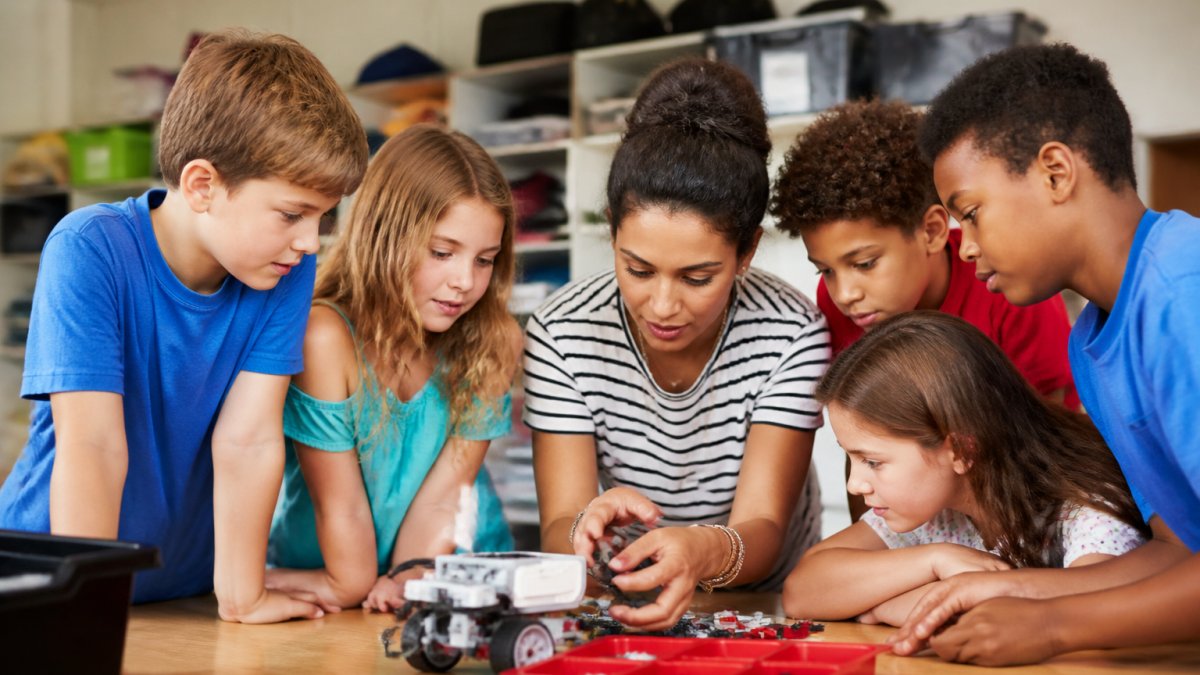
Begin with your existing curriculum. Where does critical thinking already appear? Where do students evaluate sources? These moments are entry points for AI literacy. A lesson on fact-checking news articles becomes a lesson on fact-checking AI outputs.
Many free resources exist. Common Sense Media has AI literacy lesson plans. ISTE offers professional development. CodeAlgo Academy provides standards-aligned curriculum designed specifically for K-8 teachers without coding backgrounds.
Building Teacher Confidence and Professional Development
Many teachers feel intimidated by AI. The solution is direct experience and community. The ISTE Standards for Educators provide a framework for integrating technology, including AI, into teaching.
Research from the National Center for Education Statistics shows that teacher confidence directly impacts student learning. When teachers understand a topic well, they teach it more effectively. Invest time in your own AI literacy first.
Connect with other educators doing this work. Share what you learn. If one lesson doesn't work, adjust it.
Start with one clear goal: help students understand that AI is a tool built by humans, with human choices embedded in it. From there, build outward. Use CodeAlgo Academy's resources to scaffold learning.
Teaching AI literacy in K-8 schools prepares students for a technology-driven future where they'll encounter AI daily.
Frequently Asked Questions
What is AI literacy for K-8 students?
AI literacy for K-8 students is the ability to understand how artificial intelligence works, recognize its applications in daily life, and think critically about its limitations and ethical implications. It includes knowing what generative AI can and cannot do, understanding how chatbots process information, and developing skills to evaluate AI-generated content. This foundation prepares students to work confidently with AI tools throughout their education and careers.
Why is teaching AI literacy in K-8 schools important?
Teaching AI literacy early builds critical thinking, problem-solving, and digital literacy skills that students need for a technology-driven future. Students who understand AI foundations develop healthier skepticism about information sources, recognize bias and limitations in AI systems, and gain confidence working with emerging tools. Early exposure also helps close equity gaps by ensuring all students, regardless of background, develop these essential competencies before high school.
How can I teach AI literacy if I've never coded before?
You don't need coding experience to teach AI literacy. Focus on conceptual understanding: explain how chatbots learn from patterns, demonstrate AI limitations through examples, and facilitate discussions about bias and ethics. Use game-based learning platforms designed for K-8 students that require no coding background from teachers. Many curriculum resources provide ready-to-use lesson plans, discussion prompts, and activities that guide both you and your students through AI concepts hands-on without technical jargon.
What standards align with AI literacy curriculum for elementary students?
AI literacy curriculum aligns with Computer Science Teachers Association (CSTA) standards, Common Core State Standards (CCSS), and Next Generation Science Standards (NGSS). Standards-aligned programs structure AI instruction by grade band, ensuring age-appropriate depth. Elementary students typically focus on recognizing AI in everyday life and understanding basic concepts, while middle schoolers explore how generative AI works and evaluate its accuracy. Using standards-aligned resources ensures your instruction meets state requirements and prepares students for secondary computer science.
How do you measure whether students are actually learning AI literacy?
Measure AI literacy through formative and summative assessments: observation of student discussions about AI bias, written reflections on how AI tools work, project-based assignments where students evaluate AI outputs, and performance tasks where they identify limitations in chatbot responses. Track growth in critical thinking by reviewing how students' questions and reasoning evolve. Platforms with adaptive learning track problem-solving progress and skill mastery in related areas like logic and computational thinking, providing concrete data on learning outcomes.
What are the main ethical considerations when teaching AI to children?
Key ethical considerations include teaching students to recognize bias in AI systems, understand privacy and data use, respect copyright when working with AI-generated content, and practice academic integrity by disclosing when they use AI tools. Address misinformation by helping students fact-check AI outputs and understand hallucinations. Discuss fairness, consent, and how AI decisions affect real people. Age-appropriate lessons help younger students grasp these ideas through concrete examples, while middle schoolers can engage with more complex scenarios involving real-world AI applications.
How does game-based learning help teach AI concepts?
Game-based learning makes abstract AI concepts concrete and engaging. Students practice critical thinking and problem-solving through interactive challenges, receive immediate feedback that builds understanding, and develop persistence as they progress through levels. Games reduce intimidation for students new to technology and make lessons feel purposeful rather than passive. Adaptive game mechanics adjust difficulty to each student's level, ensuring all learners stay challenged without frustration. This approach also supports healthy screen time by combining learning with meaningful interaction.