 how-to
Building Number Sense Through Problem Solving Games
Last Updated: November 12, 2026
Quick Summary
Building number sense through problem solving games works because a game forces a child to make a decision, not repeat a rule. Simple dice and card games like Roll and Build, Card Compare and Make Ten turn number sense practice into five minutes of nightly thinking.
- A worksheet asks a child to recall, while a game asks a child to think.
- Roll and Build: roll two dice, build the total with counters, say how many more to reach 10.
- For grades 3 to 5, shift from counting to place value and estimation activities.
- A number path gives each number its own box, so kids can step forward and back.
- Print PDFs your child writes on and skip colorful posters and long drill packets.
Table of Contents
- Why Problem Solving Games Build Number Sense That Sticks
- Number Sense Games for K-2: Dice, Cards and Counting Play
- Number Sense Activities Grade 3 to 5: When Numbers Get Bigger
- Number Paths: The Simple Tool That Makes Number Lines Click
- Number Sense Activities PDF: What to Print and What to Skip
- Number Sense Games Online: Choosing Screen Time That Makes Kids Think
- Start Your First Week of Number Sense Games
- Frequently Asked Questions
Why Problem Solving Games Build Number Sense That Sticks
Number sense is the ability to understand how numbers work together, not just to memorize facts about them. And building number sense through problem solving games works because the game forces a child to make a decision, not repeat a rule.
A worksheet asks a child to recall. A game asks a child to think. That gap matters. Research on early-grade math practice describes dice and card games as low-cost, readily available tools that support mental math and number sense development (South African Journal of Childhood Education article on games and number sense).
A child who races through a game without thinking may not be learning much. A child who pauses to break a problem apart is building skills that tend to last.
What Number Sense Actually Means for a 6-Year-Old
For a 6-year-old, number sense means knowing that 7 is bigger than 5 without counting, that 10 can be split into 6 and 4, and that adding 2 to a number makes it jump forward.
It is not the same as knowing answers. It is knowing why the answers work.
- Comparing: spotting which group has more at a glance
- Breaking apart: seeing 8 as 5 plus 3
- Estimating: guessing "about 20" and being close
- Flexing: solving 9 + 4 as 10 + 3
A child with strong number sense can take a wrong turn and self-correct. That is the skill that survives harder math later.
Number Sense Games for K-2: Dice, Cards and Counting Play
The best K-2 number sense games need no screen and no prep beyond a die, a deck of cards, and a handful of counters. Simple materials keep the focus on thinking.

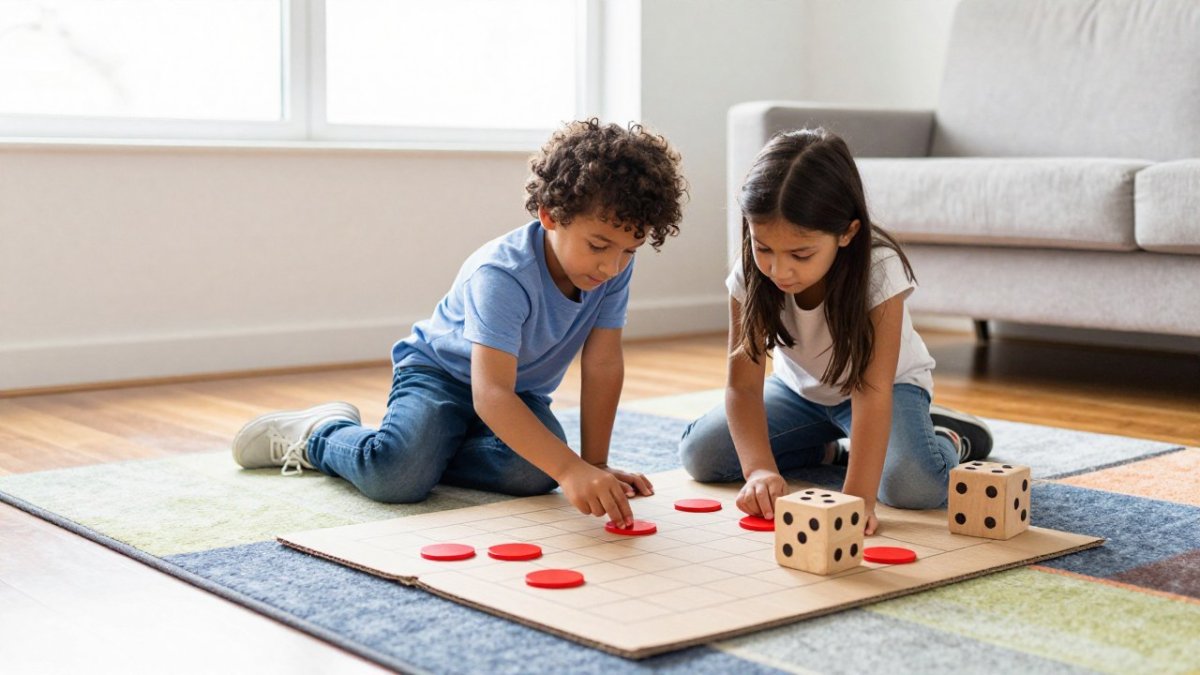
Game 1: Roll and Build. Roll two dice. Your child builds the total with counters, then says how many more to reach 10. Five minutes a night is enough.
Game 2: Card Compare. Deal one card each. Higher card wins the round, but the winner must say the difference out loud.
Game 3: Make Ten. Lay five cards face up. Your child finds two that add to 10. Swap cards and repeat.
For a ready-made rotation, this guide to low prep math centers for elementary students lays out grade-banded activities and a weekly plan.
Number Sense Activities Grade 3 to 5: When Numbers Get Bigger
Grade 3 to 5 number sense activities should shift from counting to place value and estimation, because that is where most kids start to struggle. Bigger numbers expose weak foundations fast.
Try these three:
- Round and Check: Ask your child to estimate a total before adding. Then compare the estimate to the real answer.
- Place Value Build: Say "4 hundreds, 7 tens, 2 ones." Your child writes 472 and explains each digit.
- Fraction Benchmarks: Sort fractions into closer to 0, closer to ½, closer to 1.
A common mistake is jumping to speed drills here. Speed hides gaps. Estimation exposes them.
A 2025 study on foundation-phase number sense through technology-enhanced mental math found teachers brought strong content and pedagogical knowledge to the work (Selepe and colleagues on number sense through technology-enhanced mental mathematics). The lesson for parents: the adult's role is to ask good questions, not to have every answer.
If your child is falling behind as numbers grow, this guide to choosing adaptive math learning paths for struggling kids compares four common options.
Number Paths: The Simple Tool That Makes Number Lines Click
A number path is a row of connected boxes, each holding one number, that lets a child physically step from one number to the next. It is the training-wheels version of a number line.
The difference matters. On a number line, a child must judge empty space. On a number path, each number has its own box. Kids who cannot yet estimate distance can still count their way forward and back. Removing the pressure of spatial estimation allows students to focus on the logic of the sequence, a confidence-building approach explored further at Naijatutors Konnect.
- Print a path from 1 to 20 for early learners
- Move a small toy one box per step
- Ask "where will you land if you take 3 steps?"
Once a child is confident, switch to a number line. The jump feels natural.
Number Sense Activities PDF: What to Print and What to Skip
Most number sense activities PDFs are worth downloading, but only some are worth printing. Print the ones your child writes on. Skip the ones they only look at.
Here is a quick way to sort a stack:
| PDF Type | Print It? | Why |
|---|---|---|
| Number path strips | Yes | Kids step and count on them |
| Dice and card game rules | Yes | One page, used weekly |
| Ten-frame mats | Yes | Hands-on building practice |
| Colorful "number sense posters" | Skip | Wall art, not practice |
| 40-page drill packets | Skip | Repetition without thinking |
The test is simple. If the page makes your child decide something, print it. If it makes them copy, skip it.
Number Sense Games Online: Choosing Screen Time That Makes Kids Think
Online number sense games can build real skill, but only when the screen asks the child to think rather than tap. That is the whole test.
Ask three questions before you sign up:
- Does the game slow my child down to plan a move?
- Can my child explain the strategy afterward?
- Does the program adapt as my child improves?
If the answer to all three is yes, the screen time is active problem-solving, not passive watching. That distinction is the one that matters most for young learners.
CodeAlgo Academy offers game-based math and coding lessons for ages 5-14 with adaptive learning paths aligned to CCSS and CSTA. Kids can level up on web, iOS and Android, and parents need no coding background to start. Teachers can sign up free as a teacher to bring the game-based approach into the classroom.
For a wider look at healthy screen habits, read whether educational screen time is considered healthy for kids. And if you want to compare platforms side by side, this roundup of the best gamified coding and math platforms for K-8 is a fair starting point.
Start Your First Week of Number Sense Games
A first week of number sense games takes about 10 minutes a night and needs no special materials. Here is a plan you can run starting tonight.
- Monday: Roll and Build with two dice, totals to 12
- Tuesday: Card Compare, differences out loud
- Wednesday: Number path steps with a small toy
- Thursday: Make Ten with five cards
- Friday: Estimate, then check, with a small pile of counters
Keep a short note each night: what your child figured out, and where they paused. That pause is the learning.
Fun alone does not prove learning. What proves it is a child who stops, thinks, and makes a decision. CodeAlgo Academy's game-based platform pairs that kind of thinking with coding and math practice, and 41,928+ coding problems have been solved across 10 states so far.
Coding-style problem solving reinforces the same math thinking these games build. See how coding helps kids with math and problem-solving to connect the two.
The challenge is not finding games. It is finding games that make your child think instead of tap. CodeAlgo Academy gives families game-based math and coding lessons with adaptive learning paths, standards-aligned content, and measurable math growth, all on web, iOS and Android with no coding background needed. Get started with CodeAlgo Academy and turn screen time into problem-solving time.
Frequently Asked Questions
What are some games that can help build number sense?
Simple dice and card games do most of the work. Dice and card games are often described as low-cost, readily available tools for practicing mental math in early grades. Try rolling two dice and asking your child to say the total without counting on fingers, or playing a card game where the higher card wins and your child explains why. For screen time, look for number sense games online that ask kids to explain or choose a strategy rather than tap the fastest answer.
How can problem-solving games help children understand numbers?
Games put numbers inside a decision. Your child has to choose whether to add, split a number apart or estimate, and then see whether the choice worked. Game-based activities are often used to help children practice thinking with numbers rather than just recalling facts, which is what number sense actually involves.
Which number sense activities work well for elementary students?
Match the activity to the grade. In K-2, dice and counting games build the idea that numbers are made of parts. In grades 3 to 5, number paths and open number lines help with rounding, place value and mental addition. For grade 3 specifically, try asking your child to place a number like 47 on an empty line and explain the reasoning. Printable number sense activities PDF packs work well as a backup for car rides and waiting rooms.
How can parents adapt number games for different ages and skill levels?
Change the numbers, not the game. A dice game becomes harder when you add a third die or ask for the difference instead of the sum. For an older child, use larger numbers or ask them to estimate before they calculate. If your child rushes, slow the game down by requiring a one-sentence explanation of each answer. Programs with adaptive learning paths, like CodeAlgo Academy, adjust difficulty automatically, which helps when you are not sure where your child should start.